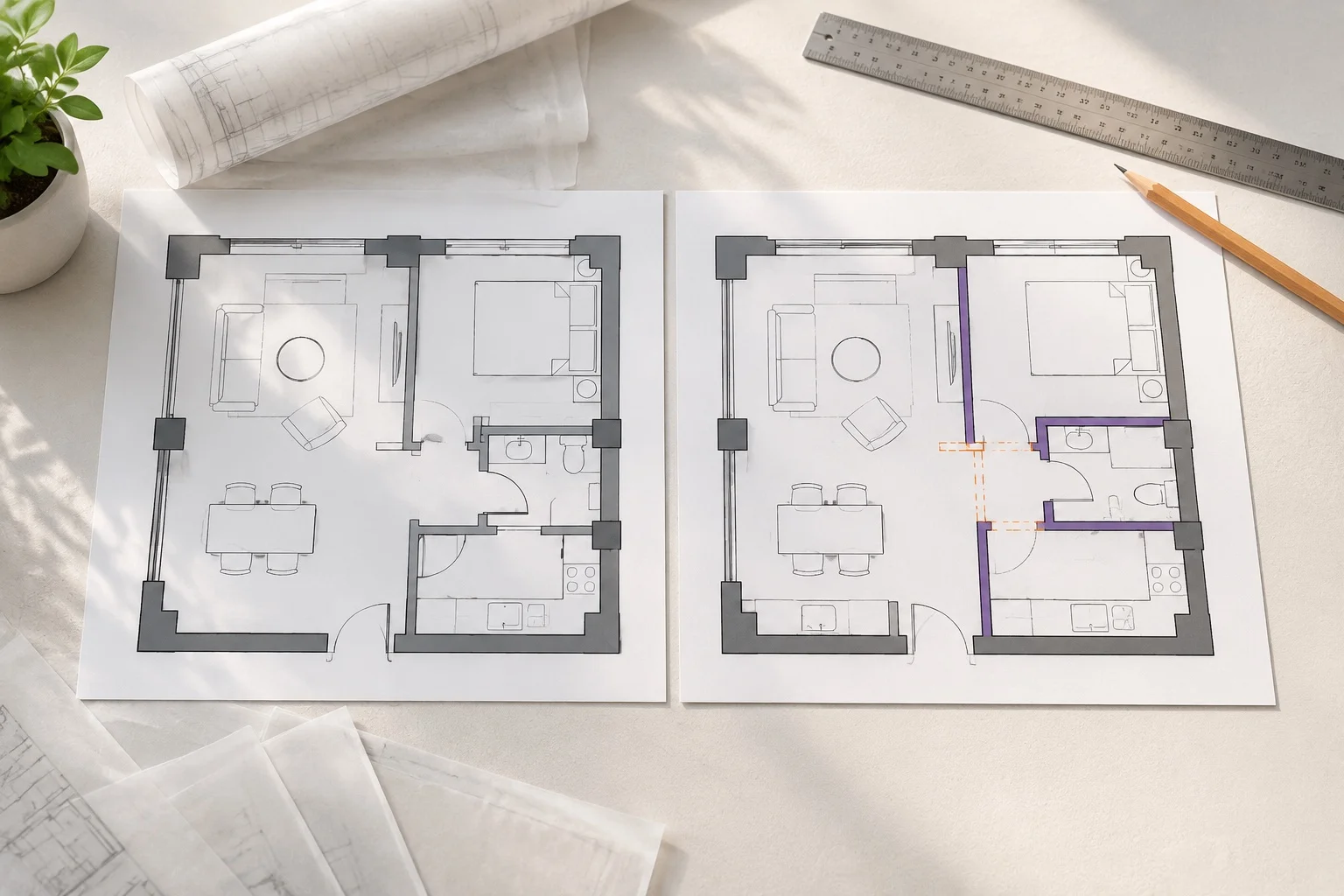
Why Assumptions Corrupt a Plan Overlay
Most failed remodel comparisons share the same root cause: the as-built sheet contains geometry that was never measured. A wall thickness copied from a 1978 print, a ceiling height carried over from the listing description, a joist direction guessed from a basement photograph — each slips into the drawing as a solid, confident line. When the proposed plan is overlaid, the comparison looks precise while resting on numbers nobody verified.
The danger is not that assumptions exist — field work always involves inference before walls are opened. The danger is that assumptions are drawn identically to verified facts. A contractor reading the sheet cannot tell the difference between a confirmed 92mm stud wall and an estimated one, so the comparison silently transfers risk downstream to framing day.
A comparison sheet is only as honest as its weakest line. If one estimated dimension looks identical to a laser-measured one, the whole set inherits that uncertainty.
Declaring Every Provisional Dimension
The first discipline is graphical segregation. Any line, hatch, or dimension that is not backed by a field measurement or a trusted prior survey receives a distinct visual treatment — typically a dashed boundary with an open dimension string, or a lighter line weight reserved exclusively for provisional data. The convention is set once in the sheet legend and applied with zero exceptions.
The second discipline is annotation discipline. Every provisional element carries a reference flag — a small numbered tag that points to the assumption ledger. A reader encountering a dashed wall segment sees tag A3, flips to the ledger, and learns exactly why the value is provisional, what it was inferred from, and what would confirm it.
Building the Assumption Ledger
The ledger is a compact table placed on the comparison sheet itself — not buried in an email thread. Each entry records four fields so the assumption can be audited and retired later:
- Tag & location — the flag number and the plan zone it marks.
- Assumed value — the dimension or condition currently drawn.
- Basis of inference — legacy print, listing data, visual estimate, or adjacent assembly logic.
- Verification path — the exact action that converts it to fact, such as a probe cut or a laser re-scan.
When verification happens, the tag is struck through, the geometry is upgraded to the verified line standard, and the ledger entry is closed with the measured value and date. The sheet therefore carries its own audit history — anyone can see which deltas were confirmed and which remain open.
Handing Off a Transparent Comparison Set
A transparent comparison set passes a simple test: delete every flagged element and the sheet still reads as a complete, honest document of what is known. Nothing essential hides inside an assumption. Before handoff, run one final pass — count the open tags, confirm each has a verification path and an owner, and state the count in the title block so the receiving team knows exactly how much of the drawing is still provisional.
This discipline costs perhaps an hour per sheet. It routinely saves thousands in avoided framing corrections, because proposed layouts are never again anchored to silent guesses dressed up as field truth.